


Impact Session with Oxford Brookes University: AI, Data & Cyber Trends Shaping 2026
Business leaders from across Oxfordshire gathered for the first OBS2026 Impact Session series, delivered in partnership with Oxford Brookes University, to explore the AI, data and cyber trends that will shape 2026 and beyond.
The session brought together leading experts from law, academia and technology to provide practical insight into one of the most fast-moving areas affecting organisations today: how to innovate confidently while managing increasing regulatory and cyber risk.
AI Governance & Compliance: What Businesses Need to Know
Luke Dixon, Partner and Head of Data & Information at Freeths LLP in Oxford, opened the session with a clear and commercially focused update on AI compliance.
Luke outlined the UK’s evolving approach to AI governance, highlighting the balance being struck between encouraging innovation and ensuring proportionate regulation. He reinforced the continuing importance of UK GDPR obligations, including transparency, accountability, risk allocation and the need for robust Data Protection Impact Assessments (DPIAs) when deploying higher-risk AI systems.
The session then examined the wider implications of the EU AI Act. With its extraterritorial reach and clearly defined roles for providers and deployers, the Act will have a significant impact on UK organisations operating in European markets. Luke explained the “Pyramid of Risk” framework and how it will determine compliance duties, enforcement exposure and financial risk.
Importantly, the discussion focused not just on regulation, but on commercial reality: reputational exposure, customer trust, board-level accountability and the competitive advantage of being compliance-ready before enforcement tightens.
Practical recommendations included:
- Establishing an AI inventory across the organisation
- Defining internal accountability and governance structures
- Embedding transparency and human oversight
- Preparing for data rights requests and incident response
- Improving AI literacy at board and operational levels
For businesses wanting to remain both compliant and competitive, the message was clear: preparation now will prevent disruption later.
AI in Action: Smart Visitor Management at Blenheim Palace
Matthias Rolf, Associate Professor at Oxford Brookes University, shared insights from a six-year collaboration with UNESCO World Heritage Site Blenheim Palace.
The partnership began in 2020 through a 32-month Knowledge Transfer Partnership (KTP) funded by InnovateUK and has since evolved into an ongoing consultancy relationship. Together, they developed a Smart Visitor Management System using sensor data across the estate, tracking footfall, ticket sales, retail and catering activity.
AI models analyse this data to:
- Predict visitor flows
- Monitor consumption patterns
- Optimise staffing levels
- Improve energy efficiency
- Prevent operational bottlenecks
The result is improved visitor experience alongside better resource allocation and operational efficiency.
Matthias highlighted key lessons learned from deploying AI in real-world, “small-data” environments — demonstrating that impactful AI does not require vast datasets, but instead thoughtful implementation aligned to specific business problems.
The case study provided a compelling example of how academia and business can collaborate to deliver measurable, practical outcomes.
Cyber Security in 2026: Why Zero Trust Matters
Closing the session, Richard Flanders, Commercial Director at Aura Technology, explored the rapidly evolving cyber threat landscape.
His presentation focused on how AI-powered attacks, deepfakes and increasingly sophisticated social engineering techniques are shifting the battleground from systems to people. Traditional perimeter-based security models are no longer sufficient.
A key highlight of the session was the concept of Zero Trust — the principle of “never trust, always verify.” As attackers become more behaviour-driven and harder to detect, Zero Trust architecture ensures that every access request is authenticated, authorised and continuously validated.
The discussion sparked significant audience engagement, reinforcing how critical proactive cyber strategy has become for boards and leadership teams.
The overarching message: visibility, timing and resilience now define effective incident response — and organisations that modernise their security posture will be significantly better positioned to withstand emerging threats.
Continuing the Conversation
The Impact Sessions form part of the wider Oxfordshire Business Summit (OBS) programme, bringing together senior decision-makers, academic leaders and industry experts to address the defining business challenges of our time.
Further information about upcoming Impact Sessions can be found at:
www.oxfordshirebusinesssummit.com/attend-impact-sessions
Footnote: About OBS2026
OBS2026 will build on the momentum of this year’s discussions, convening regional, national and international business leaders to explore innovation, leadership, sustainability and the technologies shaping the future economy. The Summit continues to position Oxfordshire at the forefront of forward-thinking enterprise, collaboration and strategic insight.
Warning: Undefined array key "author_person" in /home/b4business/public_html/wp-content/themes/b4-2020/functions.php on line 121
Warning: Trying to access array offset on value of type null in /home/b4business/public_html/wp-content/themes/b4-2020/functions.php on line 121

More in Tech, IT & Comms

Inclusivity in youth rugby: Darren Rea is honoured at UK Coaching...
Last week at the UK Coaching Awards in Leeds, our colleague, Darren Rea was recognised for his inspirational work coaching young people with Special Educational Needs and Disabilities (SEND).
Discover How to Use AI Safely to Grow & Future-Proof Your...
One hundred local business leaders will gather on Friday 19th September 2025 at the Leonardo Royal Hotel Oxford for a high-impact networking breakfast and extended workshop designed to help SMEs harness the power of AI — safely, securely, and with immediate business benefit.
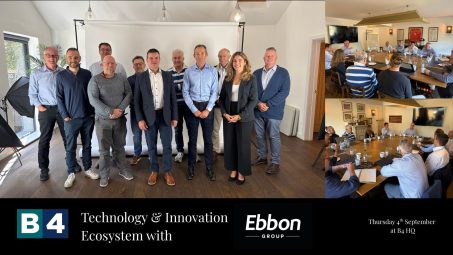
Tech & Innovation Ecosystem with Ebbon Group
B4 was delighted to host a recent Tech & Innovation Ecosystem roundtable with Craig Gibbin and Rob Pilkington, Joint CEOs of Ebbon Group. The session brought together 12 leaders to gain a deeper insight into how this pioneering Oxfordshire business is shaping the future of the global automotive industry.
From this author
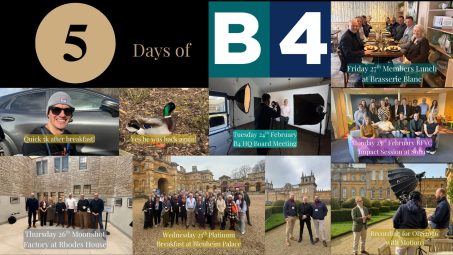
Five days. Five gatherings. One consistent theme: purposeful collaboration.
Last week was one of those weeks that reminds me exactly why B4 exists.

University of Oxford Vice Chancellor’s Christmas Drinks: A Celebration of Community,...
Sincere thanks to Professor Irene Tracey, Vice Chancellor of the University of Oxford, and Professor Alex Betts, Pro-Vice-Chancellor (External Engagement, Sport, and Community, for the kind invitation to this year’s Christmas Drinks — a truly memorable evening hosted in the spectacular Life and Mind Building, one of the most impressive additions to Oxford’s innovation landscape.

The Customer Test: When Service Fails the Customer
CASE 1: Ovo Energy by B4’s CEO, Richard Rosser