

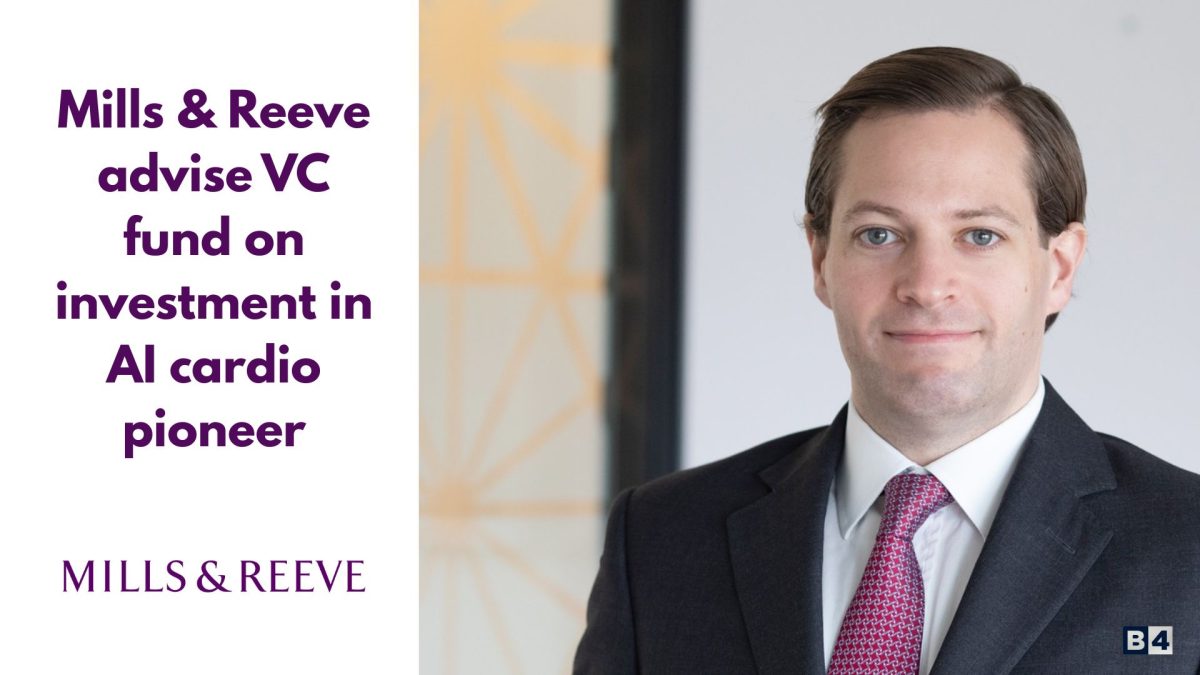
Mills & Reeve advise VC fund on investment in AI cardio pioneer
Our venture capital investment experts have advised on a $55 million Series C funding round for an Oxford-based pioneer of AI driven cardiology solutions.
Ultromics has developed the first FDA-cleared AI technology to help clinicians detect two of the most elusive forms of heart failure – HFpEF and cardiac amyloidosis.
The latest funding will enable Ultromics to expand across hospitals in the US which see the highest volume of at-risk patients, aiming to make AI-enhanced diagnostics a default step in the cardiac workup. The company is also further developing is pipeline to include additional cardiac conditions, new distribution channels and deeper partnerships with health systems and clinical leaders.
The round was co-led by Lightrock, L&G and Allegis Capital, with continued support from Oxford Science Enterprises, GV, Blue Venture Fund and Oxford University. Major US health systems, including UChicago Medicine’s venture investment vehicle (UCM Ventures), and UPMC Enterprises also participated in the round.
The team, led by partner Edward Sloan, advised Lightrock on the funding. They were also supported by Mintz Levin’s Health Law Group advising on US regulatory aspects.
Ultromic said that heart failure is rising, costs are mounting, and millions of patients are still going undiagnosed, especially those especially those with harder-to-detect forms. In the US heart failure drives over $30 billion in annual healthcare costs, a number projected to exceed $70 billion by 2030. Clinicians often rely on subjective interpretation of echocardiograms, leading to missed or delayed diagnoses even when patients are actively seeking care. Up to 64% of HFpEF cases go undiagnosed, and cardiac amyloidosis is frequently mistaken for more common forms of heart disease, leaving patients untreated until symptoms worsen or irreversible damage occurs.
Ultromics’ technology, which has been reimbursed by Medicare, addresses this diagnostic blind spot by using AI to extract hidden disease signals from standard echocardiograms, enabling earlier, more accurate detection of complex heart conditions – without requiring new hardware or disrupting clinical workflows. Its FDA-cleared EchoGo® platform supports diagnosis of HFpEF and cardiac amyloidosis.
Ross Upton, PhD, CEO and founder of Ultromics, said: “The reality is, hospitals already have the data, they just haven’t had the tools to extract the more subtle diagnostic signals from it. By analysing routine echocardiograms with AI, we’re helping clinicians identify high-risk patients earlier, enabling intervention before disease progresses.
“We’ve spent years building our platform to fit into clinical workflows, with no extra hardware and no new friction, and this funding helps us scale that across the US at a moment when health systems are actively looking to combat the growing heart failure crisis.”
Umur Hursever, partner at Lightrock, added: “Heart failure and cardiac amyloidosis impact millions of lives and strain healthcare systems, despite new approaches that have the potential to significantly improve patient outcomes. There is a critical need for scalable solutions that enable earlier, more accurate diagnosis and elevate the standard of care. Ultromics’ AI-driven technology is already making a real-world impact, improving diagnostic accuracy, supporting clinical decisions, and expanding access to specialist care.”
Our content explained
Every piece of content we create is correct on the date it’s published but please don’t rely on it as legal advice. If you’d like to speak to us about your own legal requirements, please contact one of our expert lawyers.
Warning: Undefined array key "author_person" in /home/b4business/public_html/wp-content/themes/b4-2020/functions.php on line 121
Warning: Trying to access array offset on value of type null in /home/b4business/public_html/wp-content/themes/b4-2020/functions.php on line 121

More in Professional Services

Freeths sets 2040 net zero pathway with release of first firm‑wide...
Leading law firm Freeths has just published its first Net Zero Transition Plan, marking a major step forward in the firm’s long-term commitment to responsible business. The plan sets out a clear, science-aligned pathway to achieving net zero across the value chain by 2040, underpinned by newly validated near and long-term targets from the Science […]

TalkTalk Business expands managed services portfolio with addition of Planet IT
Leading law firm Freeths has advised the selling shareholders of Planet IT on the sale of the business to TalkTalk Business, supporting TalkTalk Business’s expansion of its managed services portfolio.

James Cowper Kreston Join B4 as Platinum Members
B4 is delighted to announce that James Cowper Kreston, one of Oxfordshire and the Thames Valley’s leading firms of accountants and business advisers, has joined the B4 network as a Platinum Member.
From this author

End of 2025: Business reflections from Mills & Reeve
As we wrap up 2025, it’s a good moment to pause and reflect on what’s been an eventful year for Oxfordshire and to look ahead at what’s on the horizon for 2026.

Innovation gap opening due to varying AI adoption – Mills &...
An innovation and governance gap is opening up between businesses that realise the potential of GenAI and those that see its impact as limited, our new report has found.
According to The Critical AI Window, organisations that don’t find ways to capitalise on the potential of AI to drive innovation and growth run the risk of being left behind. As a result, competitive edge is at risk.
Our report shows that less than a third of businesses (31%) are using GenAI, with only one-fifth (22%) seeing it as high value.
Paul Knight, partner at Mills & Reeve said: “There is a clear divide amongst businesses – between those that have bought into AI and are building systems and processes around it, and those that are still unsure of its impact beyond mid- to low-value tasks, such as reducing administration and improving efficiencies and productivity.
“This divide is opening up an innovation and governance gap, as early innovators seize on the opportunities that AI presents. While our research shows that the number of businesses using GenAI is likely to rise to 72% by 2027, the lag in performance between then and now could become insurmountable.”
The report highlights the biggest concerns felt by businesses over AI adoption. The majority (90%) are concerned about inaccuracy, more than eight in ten are worried about safety risks (85%), such as cyber attacks, with the impact on future employment also a cause for concern. However, despite 83% of respondents stating that are worried about regulatory compliance, only 31% of businesses have a risk mitigation strategy in place.
Paul added: “The explosion of GenAI has seen a raft of regulations introduced across the world, with more likely, and all of them subject to change as AI understanding develops. In the UK, the regulation of AI relies on existing legal frameworks such as intellectual property, data protection and contract law, highlighting the growing need for these frameworks to be adapted to address the novel risks and complexities introduced by AI technologies. All this suggests that there will be no steady state for regulation for some time.”
However, the risk of not complying is significant, both reputationally and financially. Within the EU, under the EU AI Act, for example, violations can cause administrative fines of €35 million or 7% of total global turnover, whichever is greater.
“There is a real need for businesses to set their own guardrails as legislation in the UK catches up. If they don’t fully understand the legal and ethical boundaries – whether around data protection, intellectual property, or equality law – the consequences could be profound. A single misjudgement could expose the organisation to group litigation.”

Mills & Reeve announces record turnover of £181m as new head...
Leading UK law firm Mills & Reeve has announced turnover growth of £13 million over the 2024/25 financial year, resulting in a new high annual turnover of £181 million. Its Oxford office has seen standout success, with 55% fee growth and a new head of office appointed to lead its next chapter.