

AI for Smarter Business Development
What Actually Happened When a Room Full of Business Leaders Built Their First AI Co-Workers
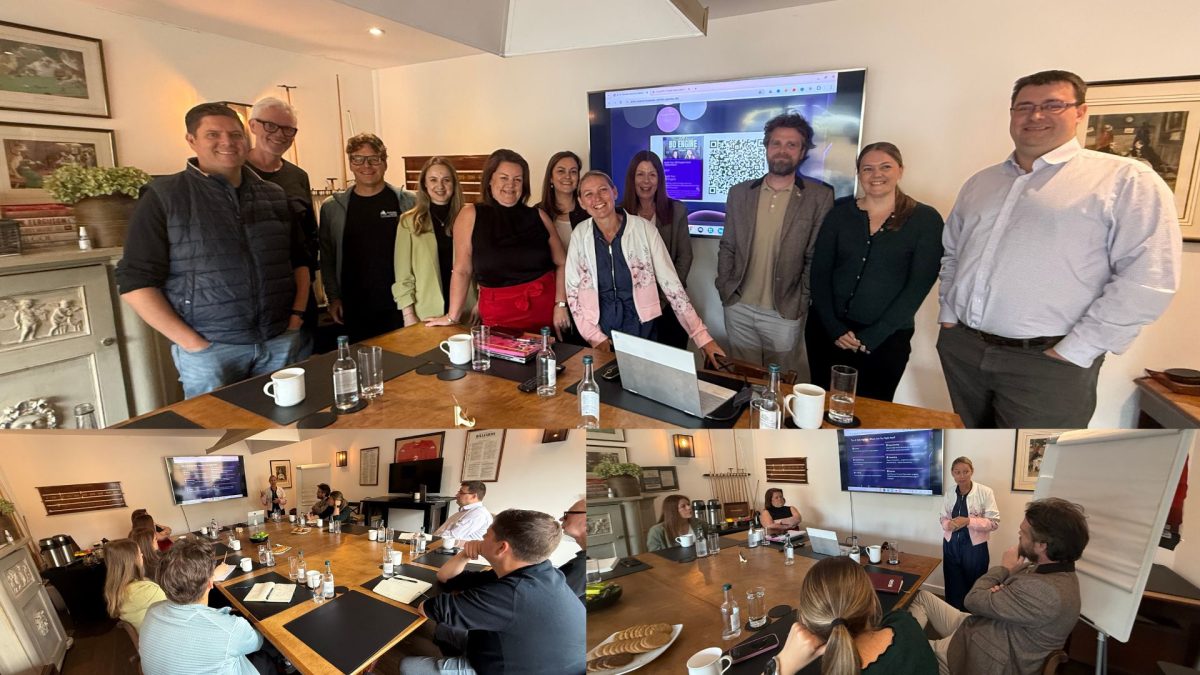
A summary of the B4 Business Development Ecosystem with AI Strategist and B4 AI Expert, Marnie Wills, hosted by B4 Business Development Expert and host of the BD Ecosystem, Caroline O’Connor
What This Session Was Really About
Everyone in the room was already using AI. That was the starting point, not the destination.
Marnie Wills, AI Strategist and founder of Business With AI Strategist, ran a hands-on session for B4 members from construction, education, charities, recycling, digital marketing, coaching and local services. The group ranged from daily ChatGPT users to Copilot subscribers to people who had barely scratched the surface.
The message was clear from the start: AI is not about replacing people. It is about increasing human capability so the business can do more. Stop chatting with AI. Start delegating real work.
The AI Maturity Map
Before diving into the build, Marnie walked through a six-level maturity map to help everyone understand where they are and where they are heading. Most of the room sat between Levels 2 and 3. The session jumped straight to Level 3.
Level 1: Curious. Using AI for general questions most days.
Level 2: Experimenting. Multiple uses daily, threads stacking up, a few other tools dotted around.
Level 3: Implementing. Building AI co-workers via Projects with custom knowledge bases and instructions.
Level 4: Integrating. Connecting AI to your business ecosystem through plugins, connectors and APIs.
Level 5: Vibe Coding. Speaking to AI and having it build functional tools, websites and applications.
Level 6: Agentic. AI agents completing multi-step tasks autonomously without you directing every move.
Marnie noted that agentic features have arrived inside Copilot and Gemini in the last eight weeks through something called Studio. If you have not explored Studio yet, it is worth a look. Templates are already there for common workflows.
What Modern Business Development Actually Covers
The session mapped the real business development function into two categories, and asked participants to rate themselves on each:
Front-end growth: lead generation and prospect research, target account prioritisation, first-touch outreach and follow-up, and opportunity qualification prep.
Relationship growth: client nurturing and re-engagement, thought leadership and visibility, messaging refinement and positioning, and insight gathering for offers and partnerships.
The universal challenge across the room was time. Not enough of it to prospect properly, research thoroughly, or make first touchpoints land with precision.
Caroline O’Connor, marketing strategist and host of B4’s longest-standing ecosystem, put it simply: if we can get a tool that helps us do this in half the time, we should.
Four AI Co-Workers for Business Development
Rather than one generic AI assistant, Marnie recommended building four focused co-workers, each with a specific job:
1. Lead Generation Strategist. Researches target sectors, builds prospect profiles, segments priorities and drafts tailored first-touch outreach.
2. Client Nurture Assistant. Surfaces warm relationships, suggests re-engagement angles and drafts thoughtful check-ins or value-add follow-ups.
3. Brand Messaging Analyst. Runs SWOT analysis, spots positioning gaps, sharpens market language and turns strategy into repeatable brand messages.
4. Research Analyst. Conducts deep research on markets, prospects, competitors, sectors and accounts so the human can make better decisions.
Participants were asked to pick one, decide what information they would need to give it on day one, and commit to building it within the week.
How to Build an AI Co-Worker: The Five-Step Process
Marnie demonstrated the full process live using Caroline’s business, Fourth Born, as the example. Here is the sequence she followed:
Step 1: Choose your ecosystem. Work out whether you are in Microsoft (Copilot), Google (Gemini) or a standalone platform like ChatGPT, Claude or Perplexity. Most people will have their ecosystem AI plus a second platform for deeper work.
Step 2: Gather your training data. This is where most people underestimate the work. Marnie identified four types of data you need:
- Raw data: human-to-human conversations like meeting transcripts, client calls and interviews.
- Real data: content you have already written, such as proposals, presentations and emails.
- Hybrid data: previous AI conversations where you refined tone, style and outputs.
- Synthetic data: research the AI gathers from the web about your market, competitors and positioning.
A key insight from the session: we may soon have more hybrid data than real data. The question of how we keep genuine human expertise in the loop is not just a tech question. It is a leadership one.
Step 3: Use meta-prompting for deep research. Instead of writing complex prompts manually, Marnie asked the AI to help write the prompt. The formula is simple: “Can you help me write a deep research prompt that will give me the following information: [list what you need]. Plus any other relevant information you think could be useful.”
That last line matters. It gives the AI permission to take initiative, just like a good team member would. The resulting prompt covered ten distinct areas and drew from 259 sources.
Step 4: Upload your sources. Add your training data as documents or text into the Project (ChatGPT), Agent (Copilot) or Gem (Gemini). This creates the co-worker’s second brain.
Step 5: Add custom instructions. This is the job description. Again, use meta-prompting: “Can you help me write custom instructions for this [role] project? The top three tasks I will do weekly are [list]. Plus any other relevant info to ensure this AI assistant is world-class.”
In ChatGPT, custom instructions go into Project Settings with a limit of 8,000 characters. If it runs too long, ask the AI to tighten it.
The key takeaway: specific knowledge and specific instructions beat hundreds of generic documents. You are fine-tuning an intern into an executive, not dumping a filing cabinet on their desk.
The Business Case: Why This Matters Now
Marnie shared data that puts the current moment into perspective:
- 54% of UK firms are now actively using AI, up from 35% just a year ago.
- 95% of SMEs using AI report no negative impact on their workforce.
- 86% say job roles remain unchanged.
- For every average-sized company, productive AI adoption could generate £4.5 million in revenue and £1.3 million in additional economic value within four years.
- 64% of jobs for Gen Alpha (born 2010 to 2023) do not currently exist yet.
At a practical level, Copilot subscriptions cost roughly £18 per month (£1.50 per day) and users report saving 22 hours per month. That is meaningful time back for any business leader who feels stretched.
The Mindset Shifts That Mattered Most
Co-creation, not generation. The critical distinction is that AI should co-create with you, not generate independently. As Marnie put it: it is not about what AI creates for you. It is about what AI co-creates with you.
Talk to your AI. We sound more genuine when we speak than when we type. Voice notes and dictation create better raw data and produce outputs that feel more authentically human.
We are in a trust recession. Generic, AI-generated content lacks credibility. People are tired of templated messaging. Success requires combining AI’s research and drafting capabilities with genuine human expertise and voice. The businesses that stand out will be the ones where AI handles the legwork and the human brings the insight.
Domain expertise is the competitive advantage. AI does not know your industry like you do. Your knowledge, experience and professional judgement are what make the AI outputs genuinely useful. Without that, you just get polished mediocrity.
Platforms Worth Watching
For participants looking beyond their existing ecosystem, Marnie highlighted several platforms:
- Perplexity for deep research, specialised agents and the broadest range of capabilities in one place.
- Gemini for free deep research (the strongest free-tier option) and Google Studio for agentic features.
- Claude for detailed, nuanced work, skills (repeatable SOPs) and artefact creation.
- Grok (Elon Musk’s xAI platform) for real-time social media insights via X.
- Meta AI (Llama and the new Manus acquisition) for next-generation agentic capabilities, already showing up in WhatsApp, Facebook and Meta Ads.
Most organisations will end up with multiple tools tailored to specific functions. Your ecosystem AI handles the day-to-day. A second platform handles the strategic, deeper work.
What the Room Committed To
Every participant left with a specific commitment. The highlights:
- Several people committed to building their first co-worker that evening.
- One participant planned to explore Gemini’s finance manager capabilities for their charity.
- Multiple attendees said meta-prompting was the single biggest takeaway.
- A self-described sceptic said this was the first AI session that showed him not just what to do, but how to do it.
- Setup time for a co-worker: the fastest on record is eight minutes with data already prepared. Most people complete it in one to two hours.
Caroline shared her own journey: in ten months, she has clawed back roughly 20 hours per week through her AI co-workers. Post-meeting admin that used to take 90 minutes now takes 15.
What Comes Next
This session showcased the process. The next step is building it for real.
In September, Caroline and Marnie are running a full-day workshop called Build Your Business Development Engine, where participants will create their Business DNA document, set up their training data folders, and build their co-workers in the room.
From the last workshop: participants were building their first co-workers that same evening. When the process clicks, it clicks fast.
Marnie is also presenting at the B4 Quorum quarterly on 17th June, facilitating a session with the head of digital innovation at LERN. For members looking to take this further, that is the next opportunity.
Marnie Wills is the founder of Business With AI Strategist and B4’s AI contributor and expert. She works with SME leaders to move from fragmented AI use to strategic, ethical AI integration.
Warning: Undefined array key "author_person" in /home/b4business/public_html/wp-content/themes/b4-2020/functions.php on line 121
Warning: Trying to access array offset on value of type null in /home/b4business/public_html/wp-content/themes/b4-2020/functions.php on line 121
More in Tech, IT & Comms

Welcome to B4: XIST2
We’re delighted to announce that XIST2 have joined the B4 community.
XIST2 is an Oxfordshire-based digital marketing and web design agency, established in 2005, specialising in bespoke WordPress development, SEO, branding, and graphic design.
Impact Session with Oxford Brookes University: AI, Data & Cyber Trends...
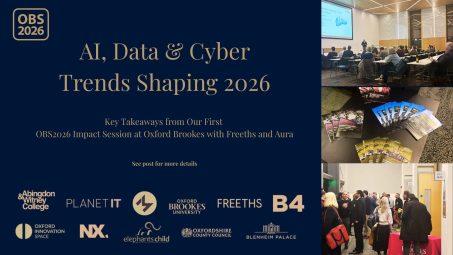
Business leaders from across Oxfordshire gathered for the first OBS2026 Impact Session series, delivered in partnership with Oxford Brookes University, to explore the AI, data and cyber trends that will shape 2026 and beyond.

Inclusivity in youth rugby: Darren Rea is honoured at UK Coaching...
Last week at the UK Coaching Awards in Leeds, our colleague, Darren Rea was recognised for his inspirational work coaching young people with Special Educational Needs and Disabilities (SEND).